

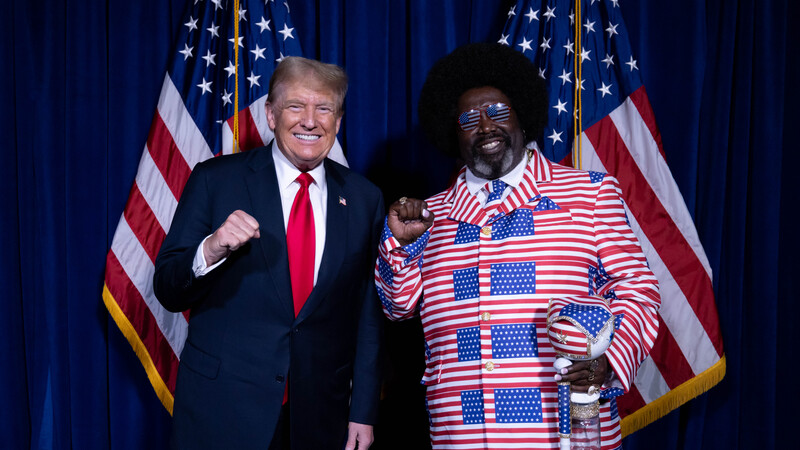
In an era where artists are constantly finding new ways to tell their stories, few have blurred the line between real life, protest, and music quite like Afroman. Known to many for his laid-back hit “Because I Got High,” Afroman has, in recent years, stepped into a very different spotlight—one that involves constitutional rights, law enforcement, and a deeply personal fight for justice.
The Raid That Sparked a Movement
Back in 2022, Afroman—real name Joseph Edgar Foreman—found himself at the center of a controversial police raid at his home in Adams County. According to reports and Afroman’s own accounts, law enforcement officers forcibly entered his property with a search warrant tied to a kidnapping and drug trafficking investigation.
But what followed, he claims, raised more questions than answers.
Police allegedly kicked in his doors, causing property damage. Inside the home, officers were captured on Afroman’s own security cameras—footage that would later become central to the entire situation. The cameras showed officers moving through the home, disconnecting surveillance systems, and searching through personal belongings.
Afroman also claimed that cash seized during the raid was returned short, suggesting discrepancies in how evidence was handled. Perhaps most notably, after the search turned up nothing that led to charges, no apology was issued.
No arrests. No charges. No closure.
Turning Surveillance Into Sound
For many, that might have been the end of a frustrating chapter. But for Afroman, it became the beginning of a new creative and legal battle.
Using the very footage captured inside his home, Afroman did something few artists would dare—he turned it into music.
Songs like “Why You Disconnecting My Video Camera,” “Will You Help Me Repair My Door?”, and the viral “Lemon Pound Cake” weren’t just tracks—they were statements. Each one used real clips from the raid, blending humor, satire, and criticism into a form of protest that felt uniquely his own.
The videos quickly spread online, drawing both laughter and serious debate. Supporters saw it as a clever exercise of free speech and artistic expression. Critics, particularly those involved in the raid, saw something else entirely.
From Defendant to Defendant Again
What makes this story even more unusual is what happened next: instead of the case ending with the failed investigation, several officers involved in the raid reportedly filed a lawsuit against Afroman.
Their claim? That he used their likenesses without permission and portrayed them in a defamatory or mocking light through his music videos.
In other words, the same footage recorded inside Afroman’s own home—during a search that yielded no charges—became the foundation for a legal battle against him.
Now, as Afroman returns to court in 2026, the stakes are higher than ever.
Back in Court: A Fight Bigger Than Music
This week, Afroman is once again standing in court—not as a suspect, but as a man defending his rights.
At the heart of the case are questions that go far beyond one artist or one raid:
- Do citizens have the right to use surveillance footage recorded inside their own homes?
- Where does artistic expression end and alleged defamation begin?
- Can public officials, acting in their official capacity, claim privacy in situations like this?
Afroman has made his stance clear. He positions himself as an artist standing firmly behind the United States Constitution—particularly the First Amendment, which protects freedom of speech and expression.
For him, this isn’t just about music. It’s about principle.
Music as Protest, Again
True to form, Afroman hasn’t stayed silent while the legal battle unfolds. Instead, he’s done what he does best—turning real-life conflict into music.
His latest wave of songs continues to call out individuals involved and highlight his perspective on the situation. Tracks like:
- Freedom Of Speech
- Licc’em Low Lisa
- Shawn Groomin Grooms
- Batteram Hymn Of The Police Whistle Blower
- Brian Newland Is A Flag
- Randy Walters Is A Son Of A Bitch
carry the same raw, unfiltered energy that made his earlier response go viral.
These songs aren’t polished PR statements—they’re bold, controversial, and deeply personal. Whether listeners see them as comedic, confrontational, or courageous depends largely on where they stand.
Power, Accountability, and Public Opinion
The phrase “power to the people” has been echoed by supporters following the case closely. To them, Afroman represents something bigger than a musician—he’s a symbol of pushing back against authority when it oversteps.
Critics, however, argue that there are limits to how individuals—especially public figures—should portray others, even in the name of art.
The courtroom will ultimately decide where those lines are drawn, but the court of public opinion is already in full session.
A Defining Chapter in Afroman’s Legacy
Regardless of the legal outcome, one thing is certain: this chapter has redefined Afroman’s career.
He’s no longer just the artist behind a viral hit from the early 2000s. He’s now part of a much larger conversation involving civil rights, police accountability, and the power of independent media.
In a time when many artists carefully navigate controversy, Afroman has run straight into it—camera rolling, mic on, and message clear.
And as he stands in court once again, he’s not just defending a case—he’s defending a principle:
That what happens in your home, on your cameras, and in your voice… is yours to tell.

